Key Takeaway
An industrial RO plant in Chennai costs between ₹2.5 lakh to ₹25+ lakh depending on capacity (500–10,000+ LPH). Installation takes 2–4 weeks including water analysis, system design, setup, and commissioning. Regular quarterly maintenance ensures optimal performance and 8–12 years equipment lifespan.
Industrial reverse osmosis (RO) plants are essential for factories, manufacturing units, and commercial buildings in Chennai that require large volumes of purified water. Whether you need purified water for production processes, boiler feed, or drinking purposes, choosing the right RO system is critical for operational efficiency and cost savings.
In this comprehensive guide, we cover everything from types of industrial RO plants and capacity planning to installation costs and maintenance best practices — specifically tailored for Chennai's unique water conditions.
What Is an Industrial RO Plant?
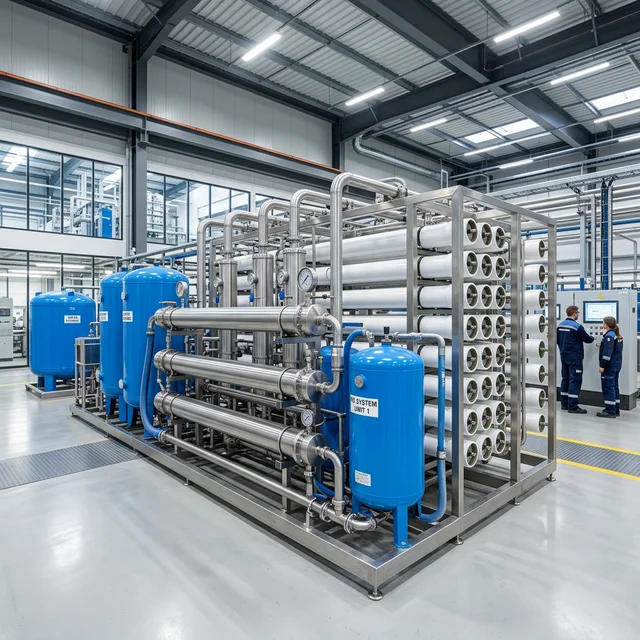
An industrial reverse osmosis plant is a large-scale water purification system that uses semi-permeable membranes to remove dissolved salts, bacteria, viruses, and other contaminants from raw water. Unlike domestic RO systems, industrial RO plants are designed to handle capacities ranging from 500 LPH to 50,000+ LPH.
Industrial RO plants typically achieve 95–99.7% rejection rates for total dissolved solids (TDS), making them ideal for applications requiring high-purity water including pharmaceutical manufacturing, food processing, electronics fabrication, and boiler feed water preparation.
Types of Industrial RO Plants
Choosing the right type of industrial RO system depends on your water source, required output quality, and production capacity. Here are the main categories:
1. Single-Pass RO Systems
Single-pass systems run raw water through one set of membranes. They are suitable for applications where moderate TDS reduction (90–98%) is acceptable. These systems are cost-effective for general industrial use such as cooling towers, washing, and utility water.
2. Double-Pass RO Systems
Double-pass systems process water through two stages of membranes, achieving TDS rejection rates above 99%. These are essential for pharmaceutical, electronics, and high-purity applications where water quality standards are stringent.
3. Brackish Water RO Systems
Designed specifically for high-TDS groundwater common in many parts of Chennai and Tamil Nadu. These systems use specialized membranes that handle TDS levels from 1,000 to 10,000 ppm.
4. Seawater RO (SWRO) Systems
For coastal industries in Chennai that use seawater as their source, SWRO systems can handle TDS levels up to 45,000 ppm using high-pressure pumps and specialized membranes.
How to Choose the Right Capacity
Selecting the correct RO plant capacity is crucial. Undersized systems lead to water shortages, while oversized systems waste capital. Follow this structured approach for accurate capacity planning:
- Calculate daily water consumption — Total water used across all processes, drinking, utility, and cooling
- Determine peak demand hours — Identify maximum hourly water requirements during operations
- Assess raw water quality — Higher TDS means lower recovery rates (typically 50–75% for industrial RO)
- Add 20–30% buffer capacity — Accounts for membrane aging, seasonal water quality changes, and future expansion
- Consider storage requirements — Plan for adequate raw water and treated water tank capacity
| Facility Type | Recommended Capacity | Estimated Cost (₹) | Installation Time |
|---|---|---|---|
| Small Factory / Workshop | 500 – 1,000 LPH | ₹2.5L – ₹5L | 1 – 2 weeks |
| Medium Manufacturing Unit | 1,000 – 5,000 LPH | ₹5L – ₹12L | 2 – 3 weeks |
| Large Industrial Plant | 5,000 – 10,000 LPH | ₹12L – ₹25L | 3 – 4 weeks |
| Mega Industrial Complex | 10,000+ LPH | ₹25L+ | 4 – 8 weeks |
The Installation Process: Step by Step
A professional RO plant installation follows a structured process to ensure optimal performance and longevity. Here's what to expect when you partner with an experienced water treatment company:
Phase 1: Site Survey & Water Analysis (2–3 Days)
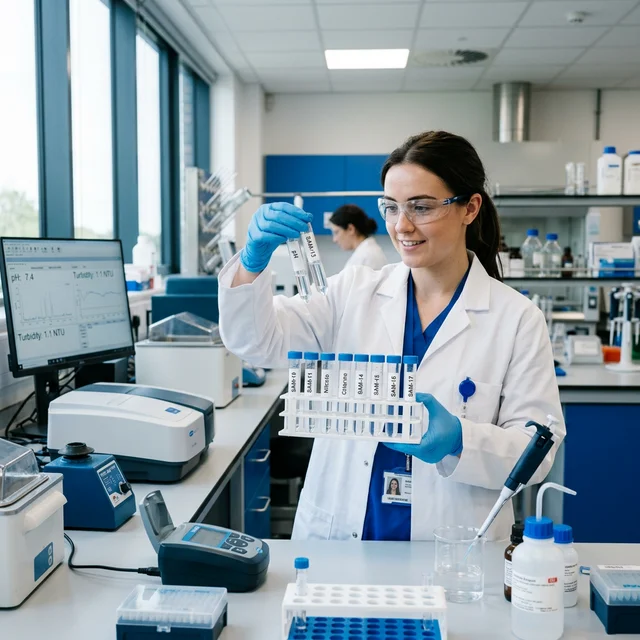
Engineers visit your facility to assess space availability, electrical infrastructure, and plumbing connections. Water samples are collected for laboratory analysis of TDS, pH, hardness, iron, silica, and bacterial count.
Phase 2: System Design & Engineering (3–5 Days)
Based on water analysis results and capacity requirements, engineers design a customized RO system including pre-treatment stages, membrane configuration, pump specifications, and control panel layout.
Phase 3: Equipment Procurement & Assembly (5–7 Days)
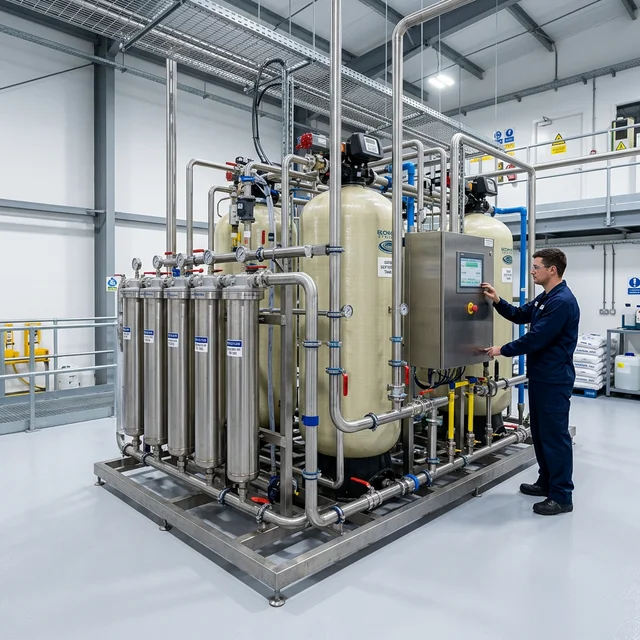
High-quality components including FRP vessels, RO membranes, high-pressure pumps, dosing systems, and SS piping are sourced and assembled at the factory or on-site.
Phase 4: Installation & Piping (5–10 Days)
The RO system is installed at your facility with proper civil, electrical, and plumbing connections. This includes mounting the skid, connecting raw water and reject lines, and installing the control panel.
Phase 5: Testing & Commissioning (2–3 Days)
The system undergoes pressure testing, membrane flushing, and performance validation. Output water quality is tested to confirm it meets specifications before handover.
Why Chennai's Water Demands Special RO Treatment
Chennai's water supply presents unique challenges that require specialized RO treatment approaches:
- High TDS groundwater — Borewell water in areas like Ambattur, Avadi, and Perungalathur often exceeds 2,000 ppm TDS
- High hardness levels — Calcium and magnesium concentrations frequently exceed 500 ppm, causing severe scaling
- Iron contamination — Many industrial areas have iron levels above 1 ppm, requiring iron removal pre-treatment
- Seasonal variation — Water quality fluctuates significantly between monsoon and summer months
- Seawater intrusion — Coastal areas face increasing salinity due to groundwater overextraction
Important
Always insist on a comprehensive water analysis before sizing your RO system. Skipping this step leads to premature membrane fouling, reduced output, and higher operating costs.
Maintenance Best Practices for Long Equipment Life
Proper maintenance is the key to maximizing your RO plant's lifespan and maintaining consistent water quality. Follow these essential maintenance practices:
- Daily monitoring — Check inlet/outlet pressure, flow rates, and output TDS readings
- Weekly checks — Inspect pre-filters, dosing tank levels, and reject flow rates
- Monthly maintenance — Replace sediment and carbon filters, clean strainers
- Quarterly service — Professional membrane cleaning (CIP), pump inspection, and electrical checks
- Annual overhaul — Membrane replacement assessment, valve servicing, and complete system audit
What Affects the Total Cost of an RO Plant?
The total investment for an industrial RO plant includes multiple cost components beyond the basic equipment price:
- Raw water quality — Higher TDS and contaminant levels require more pre-treatment stages, increasing cost
- Output capacity (LPH) — The primary cost driver: higher capacity means larger pumps, more membranes, and bigger vessels
- Automation level — Fully automatic systems with PLC controls cost more but reduce operator dependency
- Material quality — SS 304 vs SS 316 piping, branded vs generic membranes significantly impact price
- Pre-treatment requirements — Iron removal, softening, or activated carbon filtration adds to the total cost
- Civil and electrical work — Foundation, plumbing, and power connection costs vary by site
- AMC and warranty — Comprehensive annual maintenance contracts provide long-term cost predictability
Frequently Asked Questions
The cost of an industrial RO plant in Chennai ranges from ₹2.5 lakh for a 500 LPH system to ₹25 lakh or more for a 10,000 LPH system. The price depends on capacity, raw water quality, membrane type (brand), automation level, and pre-treatment requirements. Additional costs include civil work, electrical connections, and commissioning charges.
A standard industrial RO plant installation takes 2–4 weeks from initial site survey to final commissioning. This timeline includes water analysis (2–3 days), system design (3–5 days), equipment procurement and assembly (5–7 days), on-site installation (5–10 days), and testing with commissioning (2–3 days). Larger or more complex systems may take 6–8 weeks.
The required RO plant capacity depends on daily water consumption, peak demand periods, and raw water quality. Calculate your total daily water usage across all applications and add a 20–30% buffer for membrane aging and future expansion. Small factories typically need 1,000–5,000 LPH, while large industrial facilities may require 10,000+ LPH systems. A professional site survey and water analysis will provide accurate sizing recommendations.
Industrial RO plants require daily monitoring of pressure and TDS levels, monthly filter replacements, quarterly professional membrane cleaning (CIP), and annual membrane assessment. Filters (sediment and carbon) should be replaced every 1–3 months depending on water quality. RO membranes typically last 2–3 years with proper maintenance. An AMC (Annual Maintenance Contract) ensures systematic, professional upkeep and optimal performance.